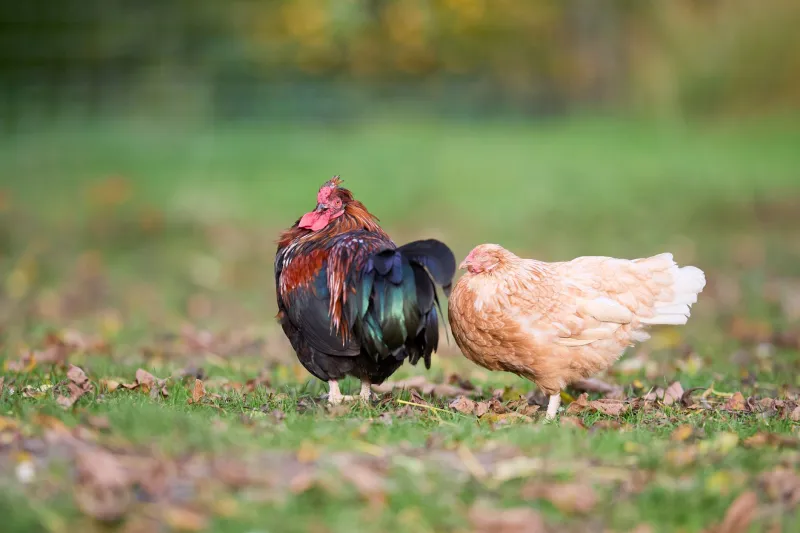
The Wonky Bird: Why a Lopsided Chicken Deserves Your Roasting Tin
Photo: N509FZ, CC BY-SA 4.0, via Wikimedia Commons
There is a bird at the back of the butcher's counter that nobody photographs. One breast sits larger than the other. The breastbone runs a degree off centre. Perhaps there's a healed kink in a wing, or a patch of skin that didn't pluck clean. It's the bird a supermarket buyer would have waved through to the mincing line, and the one I'd take home nine times out of ten.
So here is the argument, plainly: buy the wonky bird.
What wonky actually covers
It's a catch-all for anything that doesn't match the picture on the packaging. Uneven breast meat. A crooked keel bone. A repaired wing. Skin that's marked, torn or faintly blue at the shoulder. A carcass a shade under or over the weight band. A darker-feathered bird that hasn't been finished to showroom gloss.
None of that says anything about freshness, welfare or flavour. All of it affects the grade.
The grading nobody sees
Poultry sold in this country is assessed on condition and on appearance — conformation, breast development, skin quality, feathering. The top grade is a showroom standard, and anything that drifts from it gets downgraded, diverted into processing, or quietly discounted on a farm shop counter. The spec exists because shoppers buy with their eyes through a chiller door: same size, same shape, same colour, row after row.
That's a perfectly sensible thing to want if you're choosing dinner from two feet away through plastic. It's a fairly silly thing to want if the bird is going into a tin with butter under its skin and a knife taken to it at the table.
Flavour doesn't follow the tape measure
The things that make a chicken taste of something can't be graded. Age at slaughter, growth rate, what it ate, how much it moved, how patiently it was chilled. A slower-grown bird usually carries a longer leg, a sturdier frame and a higher proportion of dark meat against breast — which the grading system treats as a deviation and a cook should treat as a bonus. If your household negotiates over the legs, the wonky bird is quietly on your side.
There's a thrift argument too. Downgraded birds are usually cheaper per kilo, and a bird with more bone and more fat gives you more of the things that make the rest of the week good: a carcass worth simmering, skin worth rendering, a tin of fat for the potatoes.
Cooking a bird that isn't symmetrical
Uneven breasts mean uneven cooking if you ignore them. A few practical fixes:
- Truss loosely, or not at all. Tying the legs neatens the shape, but it also bunches the breast and makes the thick side thicker.
- Get air underneath. A trivet of onion, carrot and celery, or a V-rack, so heat moves around the bird rather than pooling under it.
- Rotate the tin halfway. Turn it, don't baste it. Basting cools the oven and the skin.
- Foil the thin side. If one breast is markedly smaller, lay foil over it for the first half of the cook, then take it off to colour.
- Cook to temperature, not to the clock. 74°C in the thickest part of the thigh, checked in two places, and a little higher in the breast if your household insists.
- Rest it properly. Twenty minutes for a small bird, more for a big one. A lopsided shape evens out on the board, not in the oven.
If the bird is seriously misshapen, spatchcock it. A flat bird doesn't have a thick side and a thin side so much as a middle and an edge, and the middle gets the attention it needs.
What to say at the counter
Ask plainly: “have you got anything going cheap today?” Butchers and farm shops routinely have birds they'd rather sell than bin, and most will tell you exactly why it's reduced. A torn wing is nothing. A bird that's been sitting about is something else entirely.
Then use your senses. The skin should be dry rather than tacky. The smell should be nothing at all. The date should be honest, and the answer to “when was this plucked?” should be a straight one. If a shop can't tell you, that's your answer.
Take it home, salt it early, roast it flat or whole, and carve it at the table. Nobody in the history of Sunday lunch has pushed back a plate because the breastbone was crooked.